TEACHING COMPUTING

The Topics
Text here
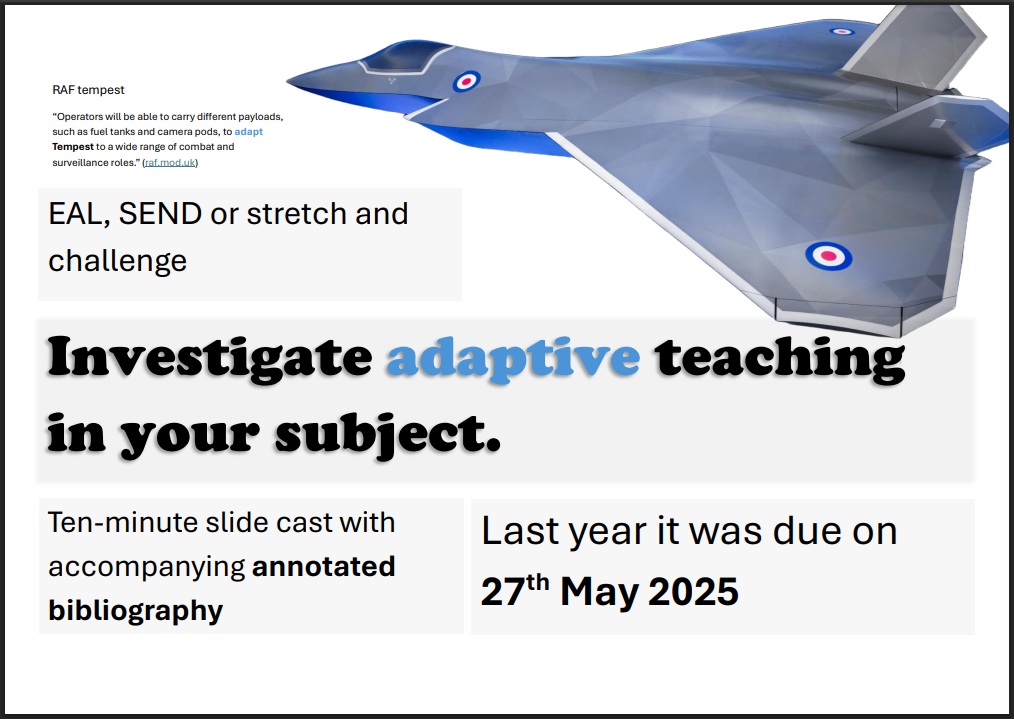
(1) INDUCTION (2) THE COMPUTING CURRICULUM (3) LESSON PLANNING (4) BEHAVIOUR MANAGEMENT (5) ACADEMIC WRITING (6) CYBER SECURITY (7) TEACHING PROGRAMMING (8) INCLUSION (9) EMPLOYMENT (10) ASSIGNMENT ON ASSESSMENT (11) THE BETT SHOW (12) ADAPTIVE TEACHINGIf a link returns 403, first visit Activate Access.
What are major problems in the teaching of computing?
Text here
If a link returns 403, first visit Activate Access.
Employability (Wed 17th Dec)
On Wednesday 17th December 2025, we are on campus learning about how to get a job. We will presumably be taling about interview technique and employability. Hosuekeeping:
- If you got a 1 for your assessment, then you can send Prof Miles a draft to get feedback on it. Remember, a 1 looks like a vertical line, and is like a flare going up in the sky; a 1 means that there is concern about your essay.
- You must ask before the 5th January. If you want a one-week extension. It won't be dealt with until after 5th Jan.
- The assignment on assessment. You need to do your own medium term planning. The idea is that you work this into the current term of work.
- The BETT show. We will all need to buy our own ticket. Publishers, exam boards, unions, foreign governments will be there. "I would really encourage you to look at the seminar programme there"
- TeenTech, 23rd April. We have the opportunity to run our own booth(?). You've got a few months to learn how to solve a Rubik's cube. Run a booth at TeenTech
Would anybody like a job next year? (joke) Process:
- Find a job
- Apply - personal statement? references?
- Interviews - demo lesson
- Would you accept?
- Negotiate
The weird thing about teaching is that they will take up references before they look at the interview. Keep in mind in the future that your future headteacher will know that you are intending to leave the school. The weirdest thing is the final question, Are you a firm candidate? Miles says that the decent thing to do is say "no" if you don't want the job...
Where to find jobs
It's very expensive for schools to use TES. It costs about £4,000 a year for schools to use it. The DfE decided they didn't like the TES having all this money from schools advertising job postings, so they made their own: teaching-vacancies.service.gov.uk/ Sometimes, Facebook job positings come up first, apparently. If schools really struggle to find teachers, they might get an agency to help them find an employee. Tom notes that Wimbledon College and other schools can seem generally offended by the very existence of agencies. If you're on their books, and you apply separately for the school, will the teaching agency sue the school, claiming they helped you find the job? "Are there any known agencies?" Miles says "Gabitas Trueman and something". TheySearching for jobs
Miles types in "computing" in the search bar on the TES website. It turns out, once the filter is set to Workplace: secondary, there are four jobs. We read through a posting from Nower Hill High School in Harrow. We point out that there is a paid induction for three weeks in July. There is a negotitation point here. Having a paid August is a very good thing indeed, because you don't want to work in August because then you'll be exhausted before you start. POint about being "qualified" comes up. Someone worries they won't have finished the course in time. Miles says negotiate here: a letter could be written from Miles to say you've filled in all the course requirements.
A slide is brought up with NFER data. They make data about the supply of computing teachers. "The current headcount of computing teachers in England is 6,504"
We are shown a graph with yellow lines and red lines and blue. There may be around 12,000 techers now.
But Miles points out that this is likely misleading. When the school admins fill out the form, they likely count individuals who teach ICT as computer science teachers also.
We are shown a graph entitled Vacancies.
There is a record high around November 2023. Why is there a dip in vacancies?
Prof Berry thinks the drop is because AI caused software develops to leave, and join the computing education profession.
This year in September (Setp 2025), 716 people are training to be computing teachers. (Miles says he thinks it is because there are fewer jobs for junior developers - Evelyn Waugh, Decline and Fall, I could always teach)
I don't think it's still the case that you can walk into any job and be in demand. Now, there may be some competition, says Miles. "I don't think it's quite the same seller's market that it was a year ago or two years ago"
We look at key documents from Nower Hill school. The Ofsted report ("they're very proud of that, that won't be much help"). "Read it, though"
"How important is the Oftsted report?" asks Lana. Miles says apply for Good and Outstanding schools first, then if you don't have a job by May then start going to other schools.
Looking at the list of things to improve on a school Oftsted report can be really helpful, says Miles. It gives you an insight into what the Senior Leadership Team will care about.
The new Education Act -- and there's a whitepaper coming next year -- will make a law that means that all state-funded schools have to offer the national curriculum, which will include teaching computing.
When the new law takes effect, even Katharine Birbalsingh will have to teach computing.
This school has a document called "Teacher of Computing - Person Specification". This is an important document! If you can write a cv/application/whatever that meets all these criteria, then you will make the HR person very happy.
Chris asks: what if we don't have one of the things on the specification. Miles says you say well I intend to gradudate this year...
You can quote from your mentor on your personal statement. Don't just say "I can do this". Provide evidence.
How do people devise this document (person specification) I ask? The HR person will speak to the Head of Computing. Much of the stuff in this document is government mandated.
I ask "what's the main tihng that would differ between different versions of this document?" Miles says the emphasis on subject knowledge versus wider, perhaps pastoral, ability.
Some schools will want somebody who can teach all levels and all aspects of the curriculum.
Other schools may want someone to teach business studies, who can also teach ICT.
They'll Google You, You Should Google Them
We look at Compare-school-performance . gov .uk We look at how many pupils are doing computing. We look at the numbers of pupils on Pupil Premium. You'd might use this data. Look at the data. You might look at the pupil premium data and say "I have a real passion for helping disadvatanged pupils" (crude example) Or you could say "I really enjoyed the lectures on EAL at Roehampton" if the school has lots of EAL pupils.Miles shows us a table in Excel (whatever he uses a Mac). Putney High School is the fourth best score in the country for Computer Science. Wilson's school is top. North London Collegiate College is second. Rugby School and Dulwich College is on here etc etc. North London Collegiate School has its GCSEs - iGCSEs - this explains why it has a lower attainment. Miles thinks that iGCSEs are easier - what's his evidence?
He answers my question. He says "the boards can set their own content". He says "I did a grade analysis at one point, and they're a grade lower". He says that there is only two third of the syllabus with iGCSE, is he right? The column he sorts by is "average grade in GCSE computer science". Miles points out that Attainment 8 is the same as the CS results score.
What on earth are they doing at Sandringham? Whatever they're doing is getting very good results for CS. Somehow they are taking the cream of the crop from their pupils, for CS. The data appears to suggest this much.
How the hell has Miles made this table?? He's able to tell us that 37% of the school study CS. Nine people got a 1 on it. One person got no grade. Miles tells us all this about Nower Hill. Use this data in your personal statement, says Miles. This data is on Moodle, says Miles.
Personal Statements
- Use examples based on your recent teaching experience
- tailor your personal statements according to the school/age group
- use good, clear, written English
- avoid cliches and general statements
- Do proof read this things. You'd be surprised how much this matters.
Relf and Hobbs have something to say in relation to What do schools want?
Often, they are looking for people who fit in, not just people who have all the subject knowledge. Relf and Hobbs write: "attention to attitudes and personal qualities needs to be a high priority"
"Can you inspire the next generation?" asks Miles.
"How do you prevent this turning into fluff?" asks Omar. "I love working with kids and I have volunteerd blah blah". Well, says Miles, the latter is better. You have volunteered. That's more like evidence. You want to show that you've done the things you say.
What do schools want?
- Enthusiasm
- Commitment and other personal attributes
- get the rest
Remember, it is a crucial, very important fact about the teacher recruiement process that: references happen first. It means when you are in your first school, you WILL at some point have to have a reference request go to the headteacher.
Immediately, they will know you want to leave the school. How does this change things? How does this change your attitude with them?
Firstly, you want to warn the person... But next?
Most of the jobs coming out now will be schools planning. They're expanding their CS team because they want to broaden the department.
If there are job postings coming out in summer, it is likely to be because of a teacher resigning.
References
Don't use personal addresses of people.
Some potential questions
- How do you improve your teaching?
- What are your weaknesses>
- How do you apply British values in your lessons?
- How do you monitor progress in computing?
- A student tells you that their father hit their mother last night. What do you do?
Would you mind explaining the comment about Dubai schools? "Well, many early career teachers go to Dubai. They have international schools there, which are based on British schools (something like this).
It suits young, energetic people to work there for a bit. However, be warned. There are very high expectations. The parents are very demanding.
It is not like private schools in England, which although they take money, do not exist to make money.... This is not the same for all schools..."
How do you embed British values into computing? Omar asks Miles, posing one of the interview questions to Miles himself. Miles demonstrates thinking on the spot. He repeats the question to himself.
We watch Obama answering a computer science question.
Would you like to ask US any questions? Miles puts some potential questsions on the board.
I ask "What are you looking for? How do you judge the questions that a person asks when they ask a question"
Miles gives a good answer. He tells us about Lynda's interview for Roe.
She asked Roehampton was rated as Good not as Outstanding, what do you think would take the organisation to Outstanding.
(Lynda's question was brave, but not negative. It wasn't say, "What's the worst thing about working here?")
Miles sketches an argument that this was good because -- and I'm interpreting his response -- it is a an exercise in empathy. This is somebody thinking about the good of the institutino. It's not a question that is used by the asker to selfishly fill up a gap in their knowledge cf. "What is the course structure like? How long do you spend in the first school?") " Sure, it seeks understanding. But it earnestly sought understanding about how the institution works. How could the instituion works?
This is a question that a competent person, truly to get the job, in antipation of doing good in the job.
Akil asks: Some people prefer supply rather than permanent teaching positions, why might this be?
Miles answers: some people have maternity leave (can't remember response), some people might be juggling two roles, ...
Not likely to happen, but there may be a pupil panel. (Tom Benneet got annoyed at them.) The pupils might ask:
- How will you make our lessons fun?
- How will you teach binary?
They were just interviewing for a Chair of Council at Roehampton governance, and there was a pupil panel for this.
What are they looking for in lessons?
"Personality" - Mounera. Other responses: do you get flustered; how do you deal with the Waldergrave use a demo lesson on abstraction as a task, Miles says. What next? What might you ask? Answer: a good start is "What have they already learned related to this topic?" "Could you tell me about any Special Eduactional Needs that I need to prepare for?" On the Facebook group, many people say "Go unplugged" for demo lessons, mainly becauseMassive issue: resources being present. Do not underestimate this. It is not trivial. USB sticks cannot be inserted into school computers. Websites will be blocked. Do not underestimate this issue. The most reliable issue is emailing resources to the interviewer (people) in advance.
You must engage all of the kids.
Miles: teaching abstraction. It's not throwing away irrelevant details. It's managing complexity.
You can ask HR, perhaps, "What facilities are available here?"
DO they use Python at the school? Don't make assumptions. In Year 8 they likely have used Scratch. But try not to make assumptions.
Negotiation
Chris was going to come. He was going to speak about negotitation. Miles: "Those of you who have had previous jobs, ask them to appoint you above M1." "If you get that, you probably don't need to negotiate much else." Other things: Could you start my appointment as soon as my course ends, so that I can get used to the school system? This may allow you to be paid over the school holidays. Perhaps ask about job-sharing. What is job-sharing? Things to watch out for: you could ask for support for ECT, which is fine. The one which you do really need to ask about, and it will not occur to you, is What is the school's pension scheme? TPS? What's it called? TDS? TPS? "IT'S AN EASY WAY TO SAVE, and you will get it back very generously, later" -Miles. "How long the state can afford to do this is a whole other thing" Academies don't have to offer TPS. Independent schools don't have to offer TPS. They have to offer a pension scheme, but not TPS. TPS is linked to your SALARY, which goes up over time.Tom: "If someone offers you an end of salary pention (is that what he said?), then TAKE IT. It is a gold-plated thing. Take it."
ENTRY000-dd/mm/yy
Talk (with AI) (Wed 3rd Dec)
We talked about talk.
ENTRY000-dd/mm/yy
Special Educational Needs and Disabilities (SEND)
On Wednesday 26th November 2025 (I think), Prof Miles talked to us about SEND and EAL.
If a link returns 403, first visit Activate Access.
Cognitive Load Theory
On Wednesday 15th October 2025, we were in our "hub schools". We talked about cognitive load theory.
If a link returns 403, first visit Activate Access.
- Still, Kristian (2022) A teacher's guide to retrieval practice
- Video lecture by Mari Cruice
- Summary Cards Example
- Accessible Booklet Example
Metacognition
"Meta" means beyond, or above. Aristotle's Metaphysics (his book) is so-named because it came after his book Physics. Cognition is the process of coming to know, particularly through thinking. Metacongnition is thinking about thinking. It involves stepping back and moving to a higher leve.
Seminal learning theories
We were given a lecture on the Philosophy of Education in the chapel on the University of Roehampton campus.
If a link returns 403, first visit Activate Access.
Technology
Prof Berry delivered a lecture on the use of technology in teaching. A live demo of using an AI to answer questions was delivered.
If a link returns 403, first visit Activate Access.
Wellbeing
On the Roehampton moodle there are some resources related to wellbeing. We didn't have a lecture on the topic.
If a link returns 403, first visit Activate Access.
Behaviour for learning
text
Click here for a the word document created.
Click here for a the PDF document created.
If a link returns 403, first visit Activate Access.
Classroom presence
How do you create a miniature lanyard to go around your neck? It is a small card that fits inside your access card holder.
What is the most effective way of doing this? There has to be a better way than simply trial-and-error. The way I did it first was by screenshotting the timetable on Google Sheets, pasting the image into Word, and then printing it off. You then manually test it. If it fits into the ID card holder, then well done. If it is too large, make the image on Word slightly smaller.
The process of printing, testing, and readusting repeats. When you need to print a new version, you repeat the process. Surely there is a better way.
Click here for a the word document created.
Click here for a the PDF document created.
If a link returns 403, first visit Activate Access.
Adolescent development
MCO showed me how to click the "filter" icon.
Go to the folder entitled "Computer Science Dept [KS3]". Make sure you are on the KS3 folder.
Go to the tab entitled simply "7" (in the bar at the bottom).
Look at the columns carefullly: you should see one entitled Teaching Group.
9B
Click this hyperlink to view my instructions for how to view and manipulate student homework grades.
Click here for a the word document created.
Click here for a the PDF document created.
If a link returns 403, first visit Activate Access.
Philosophy of Education
We were given a lecture on the Philosophy of Education in the chapel on the University of Roehampton campus. Carrie Winstanley gave the lecture. It was a romp through some notable names in the philosophy of education.
If a link returns 403, first visit Activate Access.
Safeguarding
We were given a lecture on safeguarding, in the chapel, by Matthew Sossick. Sossick is the head of Initial Teacher Education.
If a link returns 403, first visit Activate Access.
Seminal learning theories
We were given a lecture on the Philosophy of Education in the chapel on the University of Roehampton campus.

If a link returns 403, first visit Activate Access.