ITAP

These are the sessions Roehampton University are providing, in Intensive Training and Practice (ITAP).
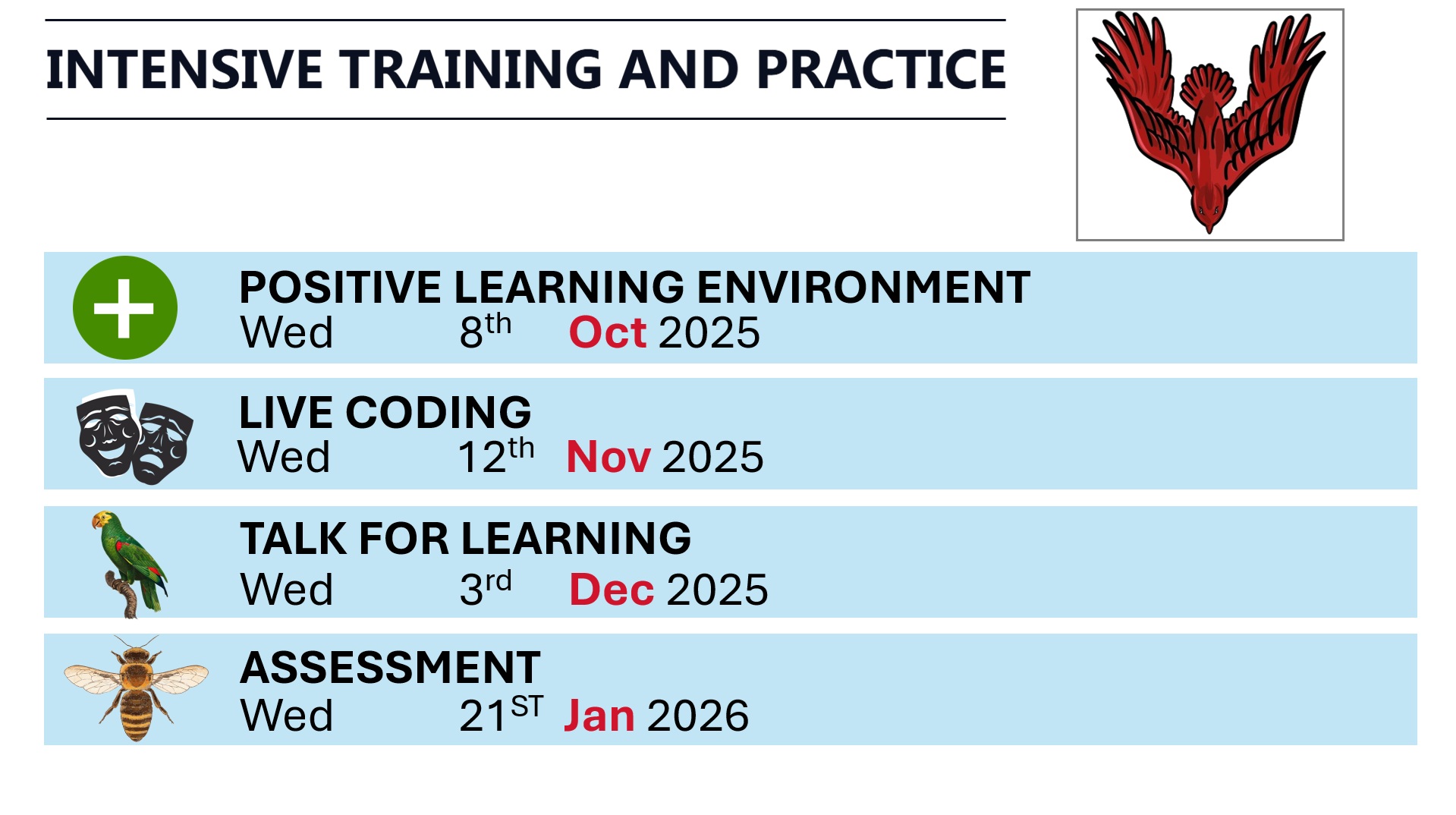
ENTRY000-29/10/25>
MY REFLECTIONS
These are the sessions Roehampton University are providing, in Intensive Training and Practice (ITAP).
ENTRY000-29/10/25>
PAM GROSSMAN
The booklet provided by Roehampton University mentions the work of Pam Grossman,
now an emeritus professor at the University of Pennsylvania. She co-authored a
2009 paper arguing that greater emphasis should be placed on the clinical
aspects of teacher training. Grossman notes that many people in society teach—
Scout leaders, employers, coaches—but not all are classroom teachers.
Emphasising the practices that are unique to classroom work helps teachers
to characterise themselves as professionals. The term “clinical”
traditionally refers to interactions with patients rather than theoretical or
laboratory study. It derives from the Ancient Greek word
κλίνη, meaning “bed” or “couch”, the place where a
person reclines. (Geographers use the word in clinometer for measuring
slopes.)
Although rooted in medicine, the term can be used outside that profession: its
core meaning remains the same—interaction with people, rather than abstract
or theoretical activity. By focusing on the clinical practices of teachers,
Grossman argues that teaching can be more clearly recognised as a profession.

This image is copyright. I belongs to the University of Pennsylvania. It is from: https://www.gse.upenn.edu/faculty/pam-grossman
ENTRY000-dd/mm/yy
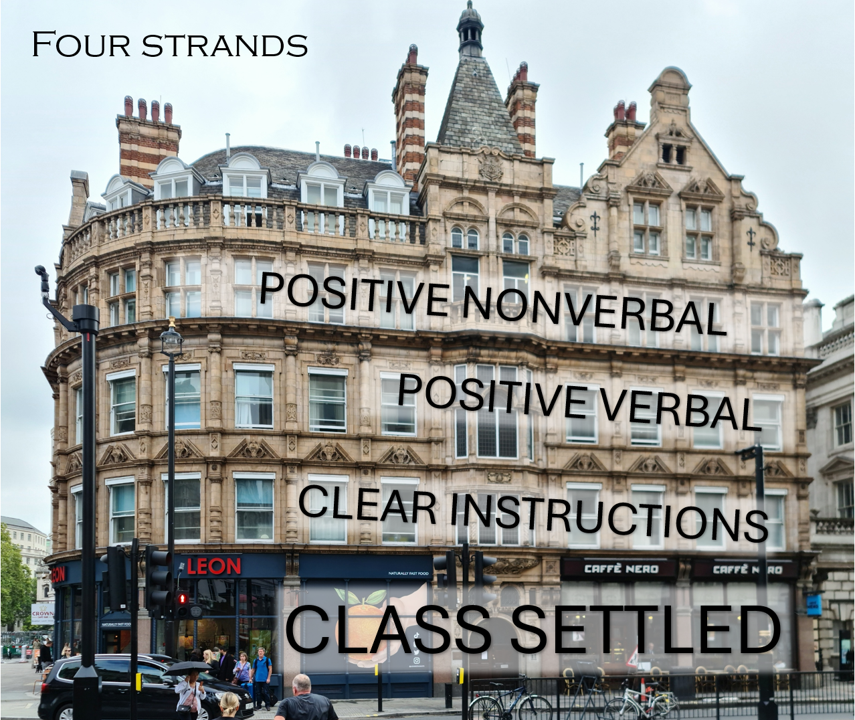
Four Strands
When we worked on our first ITAP theme, which was creating a POSITIVE LEARNING ENVIRONMENT, it was divided into four strands.
If a link returns 403, first visit Activate Access.
Live Coding notes
These are notes from the lecture on campus on 12/11/25.
Miles starts the day by talking about Lee S Shulman, and his work on signature pedagogies.
We have a framework: there is a surface structure and there is a deep structure (See Shulman.)
Miles says that in live coding, you should be showing students how to think, not how to code (is this coherent?).
(Ryle reminds us that most practical activities which are skillful involve, in his idiom, "thinking what you are doing").

Metacognition is thinking about thinking. We'll also be looking at learning about learning. Miles starts by asking: "How did you go about completing Assignment 1?" What was your process?
We compare our processes for writing essays. This is compared to the process of constructing a program. Next, we watch a video on metacognition from the Education Endowment Foundation. "Have you ever encouraged metacognition in your pupils?" The video suggests three stages: Plan, Monitor, and Evaluate. The video talks about making hints to students that the task they are set is in fact similar to something they have seen before. Rowan says that he asks pupils to read the Bebras questions twice. Tom mentions computational thinking, and breaks it into decomposition, pattern analysis, etc. Miles thinks that computational thinking is instead things like asking whether there is a similar problem.
Miles thinks that teachers should be taught about scrum at some point during school... Workers are asked What do you need to achieve? What is in your way, preventing you from achieveing these goals? The meetings are held standing up, because this makes them shorter.
Miles shows us the website from the Education Endowment Foundation. It shows that metacognitive skills are just Absolutely Amazing.
I ask whether there is a contradiction between Miles's agreement with the recent downgrading of computational thinking and his approval of metacognition. Miles clarifies his thoughts on computational thinking. Computational thinking, he thinks, is useful, and it can be applied to computable problems. Miles disapproves of teaching algorithms in the form of how to make a pizza and cup of tea. "I very much agree with Tedre and Denning" says Miles. I refer you to Lecture 2.
What have you taught pupils about how to learn? Ibrahim tells us that he has taught about data structures. Sometimes, there is more than one solution - refers to lists and tuples. Tom says the whole room was working on one challenge. People who had completed the challenge were to help others still struggling.
What have you taught your pupils about how to learn? We talk about knowledge organisers. Some teachers give their pupils knowledge organisers to help with the exam. A pupil asks for the CGP book on something - Miles wonders if it would be better for pupil to make your own notes. We talk about how teaching something is a great way to learn it. HOW TO DO METACONGNITION. See notes to fill in the contents of that slide.
We watch a video from Memorize Academy. It includes six study habits:
- Use spaced repetition.
- Interleaving.
- Use spaced repetition.
- Use examples.
- Use spaced repetition.
- Use spaced repetition.
We talk briefly about Rountree and Rountree (quotation about what distinguishes effective novices from ineffective ones: the effective ones have good strategies in place)
Omar asks questions about spaced repetition: how should we organise it? How often should it occur, the repetition?
Well, says Miles, Chris is a Tolworth and they do something from last year, last term and last lesson (is that it?).
We come back after a coffee break, beginning again at 11:20.
Roan shares a website that his mentor has made. It is at gcsecs.com We do an example question on the screen.
What is an example of a logic gate? Roan explains that he will give students ten minutes to go through the questions.
They keep going until they have them all correct.
Discussion of the trusted content store for English. Miles has a NotebookLLM on the board, which he has made. It has had many sources fed into it.
Something about how the fees for entering pupils into exams are paid for by the tax payer, but .. I can't remember what this discussion was about. Research this.
Tom introduced new topic. The conference in Bromsworth. Craig and Dave spoke there. (What did he mention about this?)
Miles critiques the way abstraction is taught in school. It is taught as the process of taking the important information, and leaving unimportant information.
It is instead about different people, in their role, having to pay attention to different things. He gives the example of programmers not having to think about facts about hardware such as the type of physical media being used.
He also, around this point, shows us an original slide from Jeanette Wing. It shows that Computational Thinking has two key components (only): abstraction and automation.
Automation is often overlooked, Miles points out. (This related to his point about abstraction - abtraction is paying attention to what you need to in order to automate something - or something like this.)
Perlis is mentioned, as someone who says that programming teaches a way of thinking.
We talk about the book by Steven Johnson, Everything Bad is Good for You. Why?
We compare live coding to both English and Maths. If programming is more like maths, then live coding is how to proceed.
But Sue Sentence thinks it's like English - in English classes in the UK: loads of reading!
What are you aiming for here? Sooner or later, they need to be able to write a program themselves.
Michael Kolling has advice about live coding. We look at this briefly.
Brown says it "slows the instructor down".
Raspberry Pi provide some advice on live coding. "Select an appropriate programming challenge to teach a new concept"; "talk to your learners and ask them questions"
Louis asks: Why is it that OCR ask for programming on paper? Miles thinks it's because OCR don't want to exclude schools which don't have enough computers.
Discussion talks to the required room layout of rooms, and internet access in schools. Miles might get us some stuff on Tim Bray from Edexcel... (?)
Miles: "I can't see how reading code helps you think about a language"
What might the challenges of writing code be? We list points on the board.
"What are English students doing for their ITAP?" asks Miles. The answer is that they are learning how to read out loud.
This confused Miles - surely they can read! But it's not the same, of course. You're learning to express what you're doing.
You're learning to emphasise certain points in what you're doing etc.
In the study by Bennett and Kemp, notice that LIVE CODING is not one of their six programming pedagogies.
Perhaps, suggests Miles, this is because it's so hard.
Miles says that you need to spend Monday rehearsing the coding. You need to rehearse, rehearse, and rehearse.
The supposed schedule:
TOMORROW - YOU OBSERVE YOUR MENTOR DOING THIS.
FRIDAY - You record yourself doing this.
MONDAY - You rehearse.
TUESDAY - You perform the live coding.
Miles gives the general principle: Do something smaller. Make it SHORTER and do it BETTER.
Miles explains that he is flexible about this. The final stage, the performance stage, can come later. Go with the local circumstances, if the local circumstances make this timetable impossible.
Miles has been quoted in SchoolsWeek magazine:
https://schoolsweek.co.uk/low-uptake-for-computer-science-gcse-spurs-review/#:~:text=%E2%80%9CNow%20we're%20in%20a,year%20than%20four%20years%20ago.
After the lunch break. Tom Jones: Teach Wimbledon are doing a session next Thursday.
Also, there is a good documentary on algorithms available on iplayer. Now onto the session. Miles says he wants us to get up to demonstrate live coding.
We're introduced to an example question: I have a £200,000 mortgage, I need to pay it back with 6% interest.
"Write a program that accepts input temperatures one at a time"
"I'm thinking of a number. People take guesses, and the response is either "too high" or "too low" "
You could do graphics. Use the Python Turtle module for this.
Code the nim game.
You could write a program that finds the mode: the most common number.
Mortgage worked through example. Let's make it an annual payment. (simplify it)
Start with £200,000
Miles writes on whiteboard with whiteboard pen. He first calculates what 6%. Then, we are paying £12,000 a month.
Is this something I can now write a program to do this?
"What do we need to keep track of? We decide upon the balance, payment rate and term.
Miles writes "def mortgage"...
Roan asks: "Can I not write a function that calculates the payment rate?" (INVESTIGATE this)
We re-iterate the question: We need to pay this all back within 25 years.
If I'm going to give the rate as a percentage, I need to divide by 100 for the sake of simplicity.
def mortgage (balance, payment, rate, term):
              rate = rate / 100
              balance = balance + rate * balance
              balance = balance - 12 * payment
              return balance
QUESTIONS ARE ASKED:
Will this work? Someone thought that the line involving addition and multiplication would not work because of BIDMAS.
Surely Guido van Rossum has inbuilt BIDMAS into his interpreter.
We then test the program by writing the line:
mortgage(200000,2000,6,25)
We use the goldilocks principle (or the principle of intermediate values).
We are trying different values for the "payment" argument.
Miles says: I think this is what you are doing - you're taking two values (one high and one low) and fidning the one in the middle.
"Ok, shall we carry on?" Everyone says yes.
We start a new function:
            def sign(x)
            if x < 0:
              return (-1)
            if x > 0:
              return(1)
            return(0)
Most people think the code would not work. Miles demonstrates it does, as the return keyword terminates the function and it works fine returning 0.
We start writing a new function:
            def solve(f, lower, upper, delta = 0.01):
              if sign(f(lower)==sign(f(upper)):
              print("set new bounds")
              return None

              mid = (lower + upper) / 2
              if abs(lower-upper) < delta:
                return mid
              if sign (f(upper))="=sign(f(mid)):
                upper = mid
              else:
                lower = mid
              return solve(f, lower, upper, delta)
Miles is working the example: "If 13,500 is not satisfactory (i.e. our midpoint is not satisfactory), What do I do?" The answer is that I need to find the middle point betewen the old midpoint and the lower point.
NO COLD CALLING. "Then what?" (Those following answer).
Projector screen goes black. Screen is fixed.
We type it out to wrap up:
            def func(x):
              return mortgage(200000, x, 6, 25)
"Now, Lana you asked: what if the mortgage rate changes?" Let's suppose the rate goes from 6% to 7%. How much more would I need to pay each month now?
We now do something else.
What did everyone think of that? How did it make you feel?
Recursion is like a threshold concept: once you get it, it changes your view of the world.
People wonder about the effectiveness of using the concepts of mortgage and payment rate. It's extra cognitive load.
solve(func, 1200, 1500)
What I thought: I don't like being asked to do little problems (what's 3 plus 4). It distracts me.
If a link returns 403, first visit Activate Access.
ITAP on Talk and AI
It is Wednesday 3rd December 2025. We are in Lulham 013, on the ground floor. We are beginning a day of talking about an ITAP theme.
The theme is that of talk and oracy and AI (all these things).
Miles asks "Does anyone have anything to say, off the record?"
One person talks about an autistic pupil who has started being silent in lessons. Another of of (student teachers) talks about witnessing SEN pupils being given more encouragement.
Miles goes through some "housekeeping" points.
First, grammar in our essays (we have just had formative feedback on our essay on programming being taught to all).
"It is important that pupils learn things themselves (Papert 1993)"Some professional academics do write like this. Perhaps we could say "One viewpoint is that blah blah". Miles says: "that might be the passive voice, but I can't be sure while speaking!" Eventually, we settle upon a good way of doing things:
Papert (1993) wrote in his book that it's really important that people have the experience of learning through making things.Prof Berry gives a non-nonsense talk about how two essays contained segments generated by AI. He knew because there were books and works that were non-existent. Both essays actually had similar structures. There was often a first section on the theoretical foundations of teaching programming. Miles was looking for an essay that talked about ways to teach programming: PRIMM, pair programming, live coding, using pseudo-code to start with (sceptical of this).
There is nothing wrong with putting papers into NotebookLM, in order to gain a greater understanding of the paper. This is something that you should put into your Acknowledgements section. Somebody asks whether it is okay to use Grammarly. Miles establishes that it is generally okay - getting Grammarly (or similar) to write in such a way that it looks like it's not written by Grammarly is certainly not right.
Lana asks a good question. How can we be critical about papers with such a tight limit on words? Critique requires lots of words. Miles responds by sort of going through the motions. You might say, he says, that the point made by this person is this. He gives the example of explaining the dialogic paper. Miles critiques critiquing things for critique's sake.
"What if there is a technique that we didn't observe?"" asks Lana. Miles concedes that an interview with your mentor can be evidence. "It' better if you've tried it out for yourself [though]" The guidance is: five techniques, two papers on each. It's best if you make connections between theory and practice. We finally begin the ITAP content.
We look at the points on the (?)ECF:
- (Require) pupils to respond to questions in full sentences, making use of relevant technical vocabulary.
- Ask questions aloud that pupils should consider when working independently
In Mind and Society Vygotsky tells us how "the child begins to perceive the world".
Language seems essential for learning
Wegerif and Mercer are neo-Vygotskians. Thinking is intimately connected with communicating.
Talk is not simply "Thinking out loud". Instead, it encourages the view that to talk, to communicate with others through speech, is to engage in a social mode of thinking. Stierer, B. and Maybin, J. (1994)
EDUCATIONAL ENDOWMENT FOUNDATION Metacongition and self-regulation is top. Then we have reading comprehension and third is oral language interventions
Prof Berry tells us a story. There was a student teacher who was observed in a classroom. They opened up for a discussion. It was regarded as a bad observation. For in the discussion, some boys dominated the discussion and girls were quiet. Miles asks:
What could she have done differently?We talk about perhaps choosing an open question, because closed questioned lead to less discussion. (Not necessarily true, I'll add) Doug Lemov is clear that you have to establish the rules first, before a class discussion. See something on ratio here 11:00 - Question from Tom about pupils turning on cats and fireworks on their Google Colab worksheets. We get into discussion about how Google gives nice breakfasts for heads of IT from multi-academy trusts.
We look at document: "Use Cases for Generative AI in education". Miles has discussed the general picture already, namely that DfE were very sceptical of AI and now they allow it for helping with teacher workload.
PRODUCT SAFETY. Generative AI products must effectively and reliably orevent access to harmful and inappropriate content by users. The generative AI product must...We break at 11:11.
House of Lords: AI in the UK: Ready Willing and able? UNESCO have their "They should learn how to use AI effectively, "
We look at a slide which is called "Issues that secondary school teachers see with AI". Plagiarism, pupils exposed to misinformation, pupils getting misinformation... etc are all on the list. But "pupils not thinking" is not on the list! We point this out.
We look at a Technology in Schools survey. We point out that AI is in the computing curriculum, but often not explicitly. e.g. "undertake creative projects..."
(The question we were asked before the break was How would you design three lessons on AI)
We look at Suno which uses AI to construct songs.
Towards Dialogic Teaching. By Rubin Alexander.
How much at the start of the lesson are they talking to you? Student teachers report being told to ask questions to pupils. But the advice is to Lana says that the Year 7s ask too many questions. Miles: no, they don't ask too many questions. Perhaps they ask them at the wrong time. You should encourage pupils to be talking Questions are designed to encourage reasoning and speculation, says Alexander. Feedback as information and diagnosis Public and confident, clear and loud
Miles compares speaking to an AI to prayer, because it's one way. Question about pupils asking questions that are not relevant. Tom gives a tip: "ask me about it later"
Jimmy says that the wider the subject knowledge of the teacher, the more astray questions they can relate back to the topic at hand.
Alexander has a framework for dialogic teaching: COLLECTIVE, RECIPROCAL, SUPPORTIVE, CUMULATIVE, PURPOSEFUL.
Dialogic Teaching. It was reviewed by the Education Endowment Foundation. Sheffield Hallam University. Miles asks: "What do you think was the outcome of this study?" (The teachers were trained in how to get students to reason and discuss, and argue and articulate RATHER THAN MERELY RESPOND etc)
Ibrahmim (I think) asks how to encourage discussion in a subject such as CS on which things are either right or wrong. It's okay in English lessons to have discussion, because there is subjectivity. Miles says he will model how to get discussion introduced into a subject like CS...
We look at Table 7. Primary anaylsis, controlling for KS1 prior attainment, pupil Ever FSM, and school-level variables-FSM eligibility, EAL, and KS2. On ONLY ONE of the three tests, there was a statistically significant result.
We're shown a paper from Kirschner (2006). "After a half-century of advocacy... there is no body of research supporting the technique"
We're shown an infographic.
We model dialogic thinking. How does an LLM work? Miles goes round room, inviting people in. Somebody says that "it's like predictive text". "What is the difference between supervised learning and unsupervised learning?" We go around, about 4 of us having a go. Miles does provide encouragement to people's responses.
Gives example of telling an AI that some videos have cats and some videos don't have cats. For an unsupervised learning example, Miles gives example of "discovering that there are cats in videos" (there is a similar pattern in lots and lots of videos).
We talk about Eliza emulators. There was a simulation of a Rogerian psychotherapist. It's rule based, explains Miles. Merely rule based.
After lunch: new topic. EXPLORATORY TALK. We move from dialogue, now, to exploratory talk. Different types of talk:
- Disputational talk
- Cumulative Talk
- Exploratory Talk
- person speaking stands up
- persons don't interrupt
- if people are triggered, identify the scope - we discuss example of a pupil who has had a parent die in a car crash, before a discussion of the Trolley problem etc
- You could say that pupils can leave at any time
- You could say that pupils can leave at any time
- Don't steal other people's time
- You can have cards or gestures that pupils can use
- Allocated times
- Passing the microphone round or some sort of physical object that marks the speaker out
- Allowing people time to think, so that they are ready to speak, can be good
- Speak in full sentences
- Writing things down. To ensure listening. Make sure there is a limit to what is written.
- Keep it respectful.
- Keep it on topic
- End
- All relevant information is shared openly.
- Each group member should be actively encouraged to contribute to the discussion
- Everyone should listen to others attentively
Sentence starters could be used. A slide is put on the board. "I understand why you'd say that, but..." "I was just thinking of something similar..."
I ask a question about persuasion in Python. Most things have to be accepted at face value.
Slide displays the words "Morality", "legality", "ethics", "philosophy",
The fifth aim of the curriculum. "Can critically articulate the individual, cultural, and societal..." We discuss utilitarianism, and the pros and the cons. Miles outlines the basic problem of utilitarianism. Why buy a phone for my daughter if I can donate the money to children in Africa?
We discuss Kant and the categorical imperative.
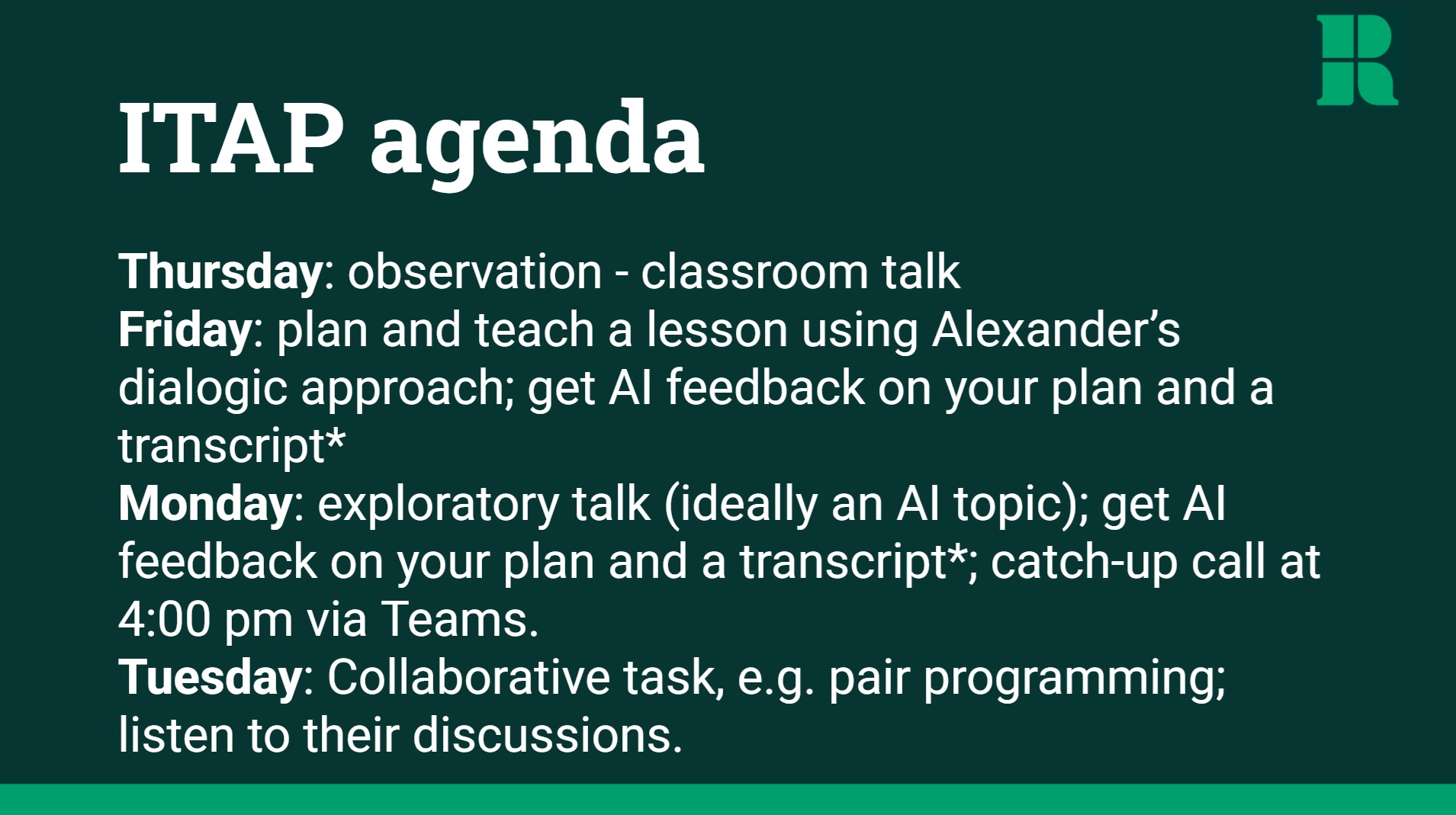
The rules for the ITAP are clarified. PRINT OFF SLIDE ON ITAP AGENDA.
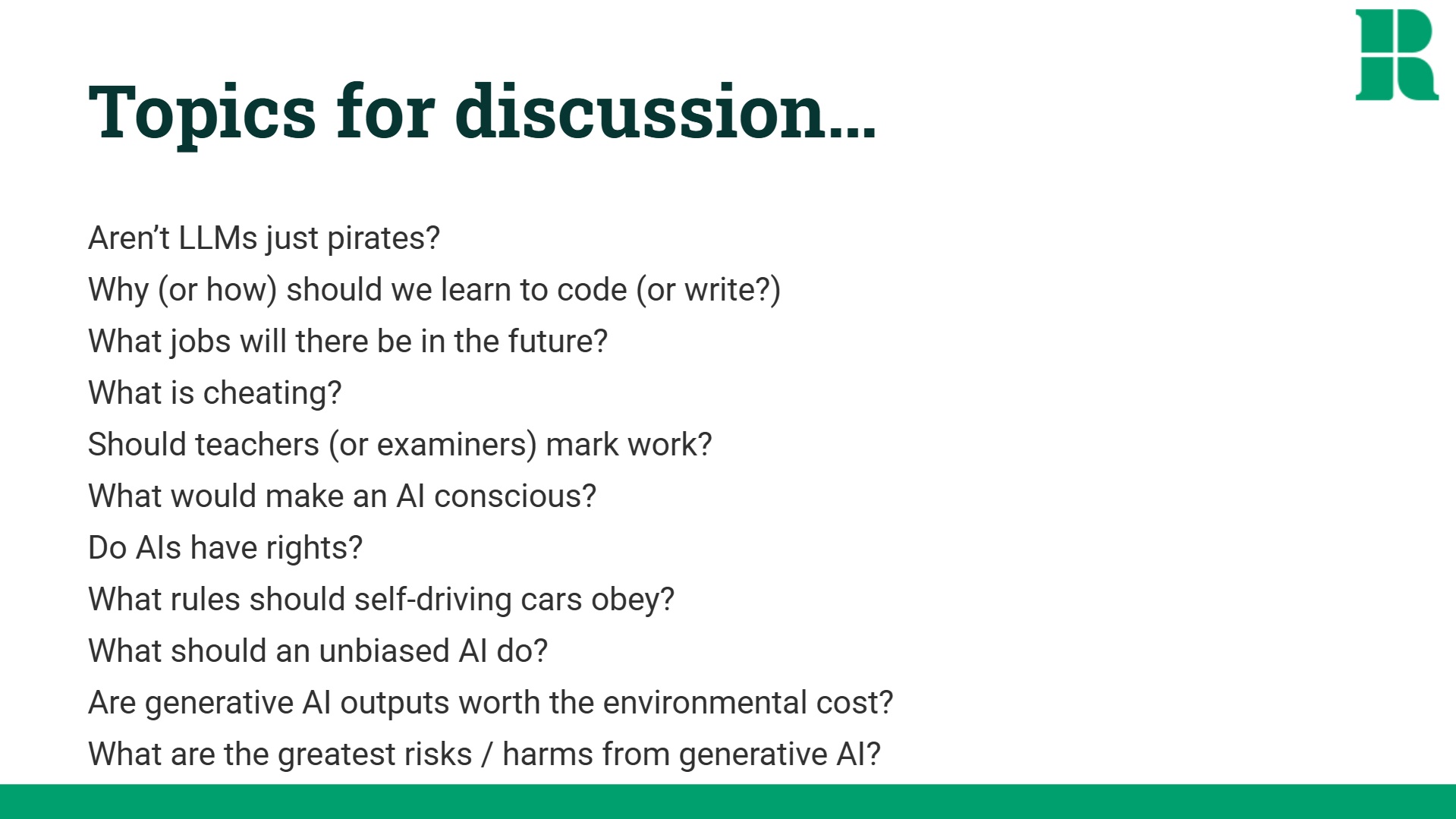
We look very briefly at a slide on collaborative cognitive load. There is a paper by John Sweller on this area.
Sweller knows about cognitive load.
Scratch has collaboration built in, says Miles, because every project has a Creative Commons License.
Miles shows four photographs. One slide shows two women walking away from a fighter jet.
One slide shows two women in a racecar.
This leads into pair programming...
The danger with pair programming is that the more capable person will just do all the work. (Tyczynska 2018)
We talk about the practicalities of pairing up pupils. How to pair a capable pupil with a less capable pupil? You could give coloured cards to pupils as they enter.
Effective pair programming:
- Prepare
- Rhythm?
ENTRY002-16/10/25
Briefly explain how expectations are established, modelled, and reinforced.